CVD & Lab-Grown
Diamond Testing Laboratory
Using advanced photoluminescence spectroscopy, FTIR analysis, and high-power digital microscopy, our certified diamond testing laboratory in Delhi distinguishes natural diamonds from synthetic CVD/HPHT laboratory-grown diamonds and identifies simulants like Moissanite and Cubic Zirconia.
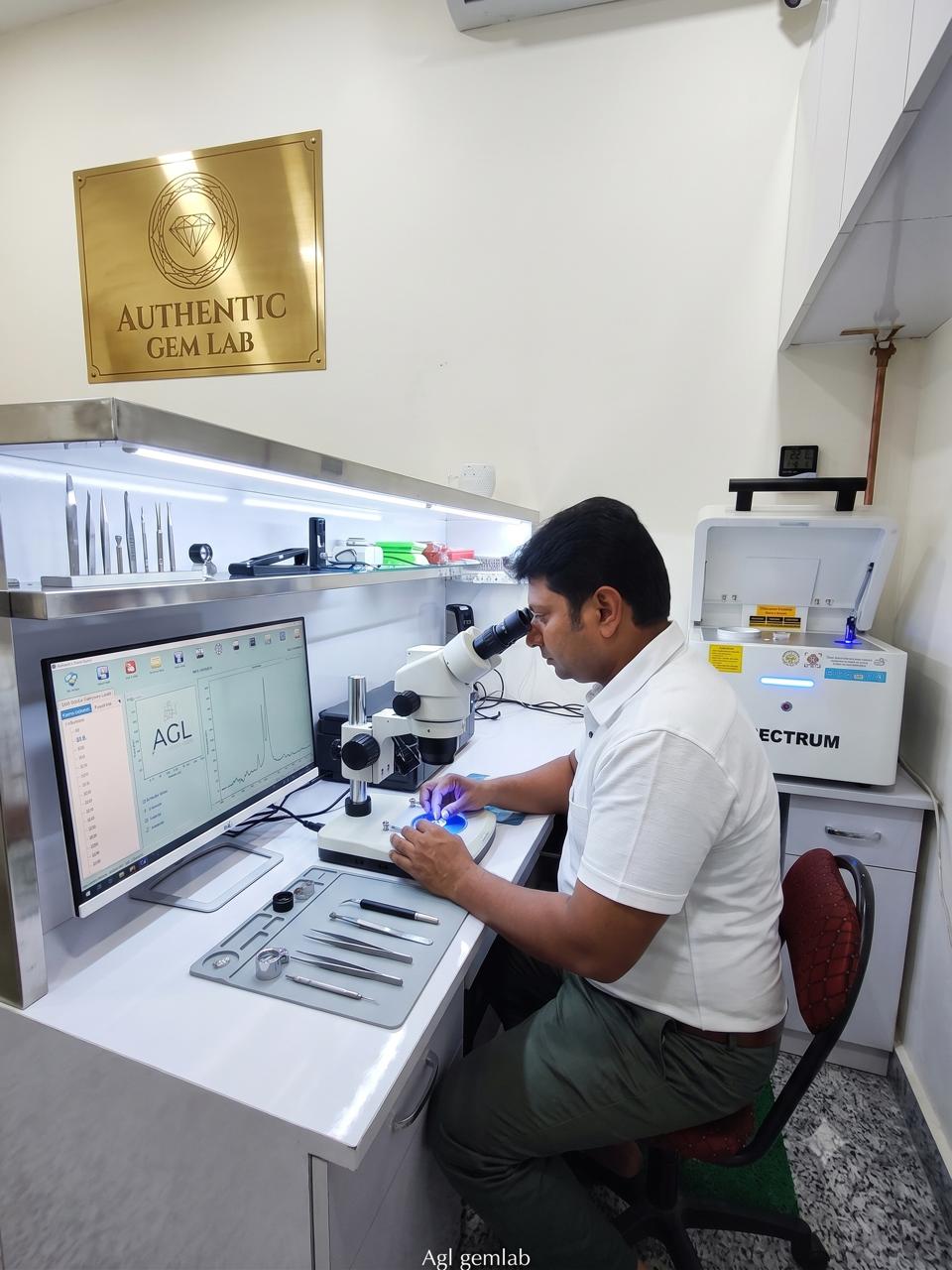
Laboratory Diagnostic Suite
While lab-grown diamonds share an identical chemical blueprint with natural stones, their crystal lattices retain distinct growth markers. Simulants differ entirely at the molecular level. Our laboratory detects these microscopic variations.
CVD & HPHT Detection
We use Photoluminescence (PL) spectroscopy to detect silicon-vacancies (CVD) or metallic fluxes (HPHT), and DiamondView ultraviolet imaging to trace geometric growth patterns and phosphorescence.
Moissanite Verification
Silicon Carbide conducts heat similarly to diamond. We isolate Moissanite by checking for double refraction (birefringence) under 10x-60x magnification and utilizing electrical conductivity.
Cubic Zirconia (CZ)
A heavy zirconium dioxide simulant. We detect Cubic Zirconia through specific gravity measurements (CZ has ~1.6x the density of diamond) and thermal resistance testing.
White Sapphire & Glass
Corundum and glass simulants lack diamond's high refractive index (RI 2.42) and dispersion. We identify them via refractometry (RI ~1.76 for Sapphire) and polariscope analysis.
Diamond & Simulant Verification Matrix
Technical properties compared to establish absolute diagnostic certainty during analysis at our Rohini laboratory.
| Material Type | Composition | Refractive Index (RI) | Thermal Conductivity | Key Distinguishing Laboratory Test |
|---|---|---|---|---|
| Natural Diamond | Carbon (C) | 2.42 (Singly Refractive) | Exceptional (~2000 W/m·K) | Natural nitrogen impurities (Type Ia/Ib), mineral inclusions, and irregular growth lines under magnification. |
| HPHT Synthetic Diamond | Carbon (C) | 2.42 (Singly Refractive) | Exceptional (~2000 W/m·K) | Metal flux inclusions (Ni, Fe, Co), strong phosphorescence, and cuboctahedral growth patterns under DiamondView. |
| CVD Synthetic Diamond | Carbon (C) | 2.42 (Singly Refractive) | Exceptional (~2000 W/m·K) | Silicon-vacancy (SiV-) defect line at 737nm detected by Photoluminescence, and tabular growth striations. |
| Moissanite (Mozinite) | Silicon Carbide (SiC) | 2.65 - 2.69 (Doubly Refractive) | High (~150 W/m·K) | Birefringence (displays facet doubling under 10x loupe), electrical conductivity, and high dispersion (intense rainbow fire). |
| Cubic Zirconia (CZ) | Zirconium Dioxide (ZrO₂) | 2.15 (Singly Refractive) | Very Low (Thermal Insulator) | High Specific Gravity (5.6 - 6.0, feels 1.6x heavier than diamond), immediate failure on standard thermal tester, lower hardness (8.5 Mohs). |
| White Sapphire | Aluminum Oxide (Al₂O₃) | 1.76 - 1.77 (Doubly Refractive) | Low | Much lower Refractive Index, lacks dispersion/fire (looks glassy), doubly refractive, and low thermal conductivity. |

Why Diamond Certification Matters
Investment Security
A laboratory-backed diamond report verifies identity and grades, protecting your capital value across all global diamond trading exchanges.
Laser-Inscribed Provenance
Tested diamonds receive a microscopic laser inscription on the girdle, linking the physical gemstone directly to its secure digital database registry.
Ethical Tracing
We strictly audit the supply chain of all submissions, ensuring diamonds certified by our laboratory are conflict-free and compliant with the Kimberley Process.
Frequently Asked Questions
Find answers to the most common queries regarding CVD/HPHT lab-grown diamond testing, 4C grading reports, and verification procedures.
What is the difference between a natural diamond and a lab-grown CVD/HPHT diamond?
keyboard_arrow_down
How does AGL distinguish natural diamonds from CVD or HPHT lab-grown diamonds?
keyboard_arrow_down
Can a standard handheld diamond tester detect CVD or HPHT synthetic diamonds?
keyboard_arrow_down
What is included in an AGL Diamond Grading Report?
keyboard_arrow_down
Begin Your Laboratory Analysis
Secure your diamond's legacy with the industry's most rigorous scientific verification. Appraisals and testing bookings available at our key global stations and Delhi headquarters.
Book a Consultation